The Rains are BACK! Its amazing to see the transformation of the land as it transitions from dry to rainy season. During the dry season, the land becomes parched, dry, everything becomes dust, dirt, and the color brown. The land literally seems to be begging for water. Within a week of the rains starting (and the the real downpours won't even start until August!) the land changes to the most vibrant, lush green you can fathom. It becomes a different view entirely and seems to almost happen overnight. You gain a whole different respect for the song, "God Bless the Rains Down in Africa".
Rains also mean that farming season is back. Meaning, that soy is consuming my life (which is OK by me, because "Insah Allah" & as long as we keep the cows away, soon we will be consuming it! Ha, jokes!)
The soy project has entered a different phase this year. I'm still working my own field on the same plot of land as I did last year. Although, since I've got no kids working with me I am only doing 1/2 the portion. Farming is T-O-U-G-H, and I'm looking to see the end of farming season! This continues to be a pilot farm. Working it serves several different purposes. I get to learn first hand about the technique behind soy agriculture (which allows me to actually have some credibility when I am trying to teach it to others). It gives me purpose and something to fill my village days with. But, most importantly, in a village where only the Divisional Officer (a government official) and a few of the high school teachers plant soy, the field (especially with its' central location) allows people to SEE soy. To believe that, "Oh, hey! This can grow on our land? WE can do this too?" One of the best moments of soy demonstrations these past couple of months was when I was in the bush and trying to teach a mean (who had purchased soy for his personal farm) how to plant soy (you have to leave 20 cm between each pod and 40 cm between each line). When I asked him if he understood he said, "Of course, I saw the way you planted your field last year." Whoah!
Another important part of using the same plot of land is that by comparing this year's future yield to last year's past yield, I will be able to learn whether or not soy is a crop that should/can be planted twice in the same field, or whether its a crop that should rotate by year.
We've also got a couple of community farms going!
After harvest, when I explained my plans for the soy to the nurse in charge, he identified three communities where he saw a lot of malnutrition cases & where he would like me to develop soy culture. Malingara, Mbigorro, and Mberse are all 5,8, and 17 km (respectively) from Dir, but all fall under our hospital's umbrella of care. These said communities are the ones that I have been working with over the past couple of months, doing nutritional lessons and culinary demonstrations to teach them the value of soy and get them interested in it.
Mbigorro is a refugee camp, composed of about 100 individuals who fled the Republic of Central Africa 4 years ago due to persecution by opposing ethnic groups. I've been working with a group of about 15 women here, who are absolutely wonderful. One of my LEAST favorite things about being a Peace Corps Volunteer is that sometimes you have to be behind individuals nagging and nagging to make sure that things get done. These women are the absolute opposite of that, and despite the fact that they only speak dialect, whenever I tell them, "I'll be back in 5 days, you need to finish laboring this portion, or, you need to continue to weed here, or, I want to see the farm fully planted" they always get it done. It's amazing, and so motivating to understand (by their work)that this is something they WANT. Unfortunately, cows have started eating some of our soy (it's sprouted!) and unless they make a fence our work will be futile.(Cows are a huge problem, and their are MANY Agro-Pastoral conflicts in the Adamaoua) So fingers crossed that when I make my next visit to these women, their will be a fence surrounding their field!
In Malingara, it is mostly only one extended family who is working the "community farm". Of course, in an ideal world the whole village would be interested, enthused, and willing to work the farm, but alas, that's not the case. However, I've learned that development is slow slow work, and I believe that if the villagers can see one family profitting from soy, maybe next year two or three families will plant soy in their fields, and the next year, maybe two or three more...
Ironically enough, Mberse is the village that I spent the most time and effort trying to introduce an interest in soy, to very little avail. Although 3 families have taken soy for their personal fields no members of the community have stepped up to start a community farm. Although personal fields are WONDERFUL, they are difficult to follow up with monitoring, and the benefits of a community field are that they are often in places where the community (even those who are not directly involved) can SEE the field, and that visual also provides more teaching opportunities.
Although rainy season comes with its whole slieu of blessings (you no longer have to go to the well to fill up your buckest, you just put them outside! and vurrrhhhy importantly....MANGOES arrive!) It also comes with the curse of rises in malaria in the community. Things are B-U-S-Y at the hospital this time of year!
Since so many of my health related stories in this blog are heart breakers, I thought it was about time I shared one that at the end had me jumping for joy like a banshee.
Ishmael is 4 years old, and is part of the extended family that makes up my neighbors. So although he doesn't live next to me, I see him several times a week in our concession. One Thursday morning I walk into the hospital to see his mother waiting outside the consultation room with an almost un-concious Ishmael in her hands. I was shocked. I had literally seen him 2 days prior and he was FINE, Ishmael is a serious little boy, but his behavior that Tuesday was similar to how it always was. Ishmael's body was as hard as a rock, his eyes were practically yellow, he was convulsing, and his eyes were dilated and unable to follow motion. Most scarily, he smelled. Death has a way of smelling, almost as if it's announcing its impending arrival. It's impossible to describe, but you grow familiar with it, and when I do smell it, my stomach instantly drops anticipating what's coming next. The nurse in charge immediately saw him and diagnosed him with cerebral malaria, he prescribed medicines and blood transfusions, but even then (to me at least) the chances seemed so slim.
That is the scary thing about malaria in children under 5 years old. For adults, whose bodies have developed an immunity to it, malaria can range from feeling like your having a cold, to a reaallly bad case of the flu. But, for young children whose immune systems are not yet strong, malaria can kill within a matter of hours.
Ishmael followed his treatment, and on morning 4 of the medicines I walked up to the hospital to see him sitting outside and eating, (THIS was the moment where I screamed like a banshee!) Our resources at the hospital are slim, and truly we are a preventative clinic more than an emergency one. After so many illness and moments where people come in too late and don't make it, Ishmael's recovery as a (much needed) breath of fresh air. Not only Ishmael, but since the start of malaria season we have seen 2 other little goobers come in in similar circumstances and with blood transfusions and medicines, make it! It has been so neccesary to realize that lives that I have already taken as lost causes, can be saved.
Sunday, June 9, 2013

Saturday, April 27, 2013
Quick Pictures

So simple and yet, this is one of my most recent favorite pictures. Just a snapshot of my friend Olivia and her family. To me, it so perfectly represents what a normal afternoon is like in village. Let's sit outside the kitchen and hang out.

Here I am with a group of refugee women (there is a refugee village 8 km down the road from Dir, they come from the Central African Republic and have been established there for about 3 years) after a soy culinary demonstration. This refugee village, Mbigorro, is 1/3 villages the clinic's head nurse has chosen to try to develop soy products with.

A snapshot of a Fulbe girl early in the morning as we watched the cow get slaughtered. Can you possibly imagine a 3 year old in the States watching that with such a calm look on their face? Ain't this little girl beautiful?
Wednesday, April 24, 2013
Time Flies
Yikes! Four months! Where to begin? The past 4 months have been a whirlwind of visitors (as my Mom, Dad and sister, all came out...I'm a LUCKY lucky girl that all the members of my immediate family are willing to take a "vacation" to Cameroon and experience the life of a Peace Corps Volunteer).
Right after my parent's visit I took a 3 week vacation to Senegal/Cape Verde with 2 other volunteers (Eddie and Joe). I honestly didn't think I needed a vacation, but being out of the country allowed me to do so much processing. I hadn't realized until I stepped into a more developed setting how normal poverty, death, and corruption had become to me. I needed to get away to process that. And as a bonus, I absolutely fell in love with the country of Cape Verde, its culture, its people = )
I think that the reason my vacation came at the perfect time was because my Mom ended up spending 5 weeks with me in country. That's no small hunk of change, and for her, after 2 weeks the novelty of fetching water, no electricity, bucket baths, and seeing exactly WHAT you can cook on limited seasonal ingredients, wore off, and she got to see a little bit more of what's under the surface of these people's smiling faces. That despite their laughter, and ability to dance at a moment's notice, there are so many daily suffrances.
Explaining that to my Mom, trying to put into words the things that trouble me here, brought a lot of questions to my mind.
What struck me the most about my Mom's visit was seeing her reactins to the culture and the people. She was so in awe of the tiniest details, so compassionate towards the people. In so many ways, like a little girl walking through a toy store 2 days before Christmas. Seeing her in this environment, made me realize, "Oh sweet Jesus. That was ME when I first got here." Where did my awe, wonder, and compassion go?
I know that that's part of the rule of life, and that because I have established myself here, that I am living amongst the people and being a part of the community I can't hold on to those feelings of awe forever. Nonetheless, it scared me. Volunteers say that it's really hard to NOT get jaded in your second year of service. That you do end up getting exhausted of constantly being stared at, at being seen as the "White Savior who has come to fix all the problems", of having constant demands thrown at you. And before my parent's visit I could sense those feelings starting to creep in.
However, coming back from vacation I felt the opposite. I felt so rejuvenated and refreshed. Being away made me realize that I missed my daily life in village. Coming back and seeing people's reactions was a jolt (as I realized that since I was gone for close to a month people thought I had left for good without saying good-bye). People were happy to welcome me back, happy to see me, and I realized, "Oh my goodness. I really am a part of this place now. People expect to see me walking around."
I feel myself re-dedicated to the people and the work here. Especially as I realize how quickly the rest of my time here will go (service ends in December). I'm realizing that 7 months is not much, and how i need to make the most out of it, especially and I honesty don't know if I will ever have an opportunity to live this quality of life again (although I hope that's not the case). I'm realizing what an honor it is to be living this simple life.
So, WORK: Phase II of the soy project is in swiiiiing. Meaning that culinary demonstrations and agricultural lessons are happening to teach people the nutritional value of soy, the technique of planting, and getting them interested enough that they will buy and plant their own soy beans (planting season for soy in the Adamaoua is anywhere from mid-May to mid-July).
A comical story: When my sister was visiting we spent one of the days with another volunteer, Danielle, who taught us how to make soy milk on a gas stove. We needed to learn because we had a culinary demonstration in the bush a few days later where we would be teaching people the same thing.
So, off we went to preach soy and spend the day in the bush. We gathered a small crowd (especially, since I am no longer a novelty, but a second white girl certainly was!) and people waited to see what concoction we were coming up with. We talked soy and talked in general, but 2 1/2 hours later and 3 tries the soy milk would just NOT give. I didn't know what I had done wrong and had to assume that it had something to do with the fact that we were preparing it over open wood stove instead of gas.
I rolled my eyes at Alison and said, "Oh Goodness, this is embarassing" as I had to explain to people that "Sorry folks, I actually JUST learned this 2 days ago and looks like I didn't really learn all that well. I promise next time I come back, it'll work!" I expected people to lose interest in the soy, but they all laughed and said "No worries" and then proceeded to gather around the big pot and finish the 5 kilos of boiled soy bean GOOP with smiles on their faces!!! Alison and I looked at each other in shock, so true that NO food goes to waste here.
A couple of weeks later when I was back in the bush for another demonstration I was happy to learn that nobody got sick off the new recipe (something else I feared would quickly make them lose interest in the soy!) To the contrary, they wanted more GOOP! Yikes!
On a very different note, about a month and a half ago my next door neighbor (17) gave birth at home and lost the baby. Giving birth at home is a HUGE problem in our community and something we're constantly trying to teach against at the hospital.
I can't tell you how may newborn babies come in one week after birth, or mothers for that fact, with turrrhible post partum infections (due to conditions in the bush, or the rooms they give birth in). After antibiotics the mother's are usually fine, but the babies almost always don't make it. I can't tell you how many moms have come in when they've realized the birth is complicated and cried for hospital help. At that point, the nurses at the hospital try, but it is usually too late to change the outcome of the birth (our clinic does not have facilities, and since losing our doctor in September...still waiting for a new one... no one to do C-sections). I can't tell you how many women who test positive for HIV during prenatal consultations (testing and medication is provided free to all pregnant women thanks to the Cameroonian government. Antiretroviral treatment during pregnancy (as well as birth at a hospital and treatment for the baby during breastfeeding) GREATLY decreases the chances of a baby catching the virus from their mother) give birth at home, not only putting their baby at risk, but also endangering those who assist them at home (and don't take universal precautions by wearing gloves).
What's disheartening about these situations is that they are almost all preventable. They don't NEED to happen and they CAN be avoided. These babies shouldn't be dying.
But...that's also such a hard concept to transmit to people in such a religious society who believe, "God gives, God takes away."
As much as I have seen these situations, the passing of my neighbor's baby was such a close relationship that it really hit home (literally). This was such a young girl who has come to live in our concession for the past 6 months. She was loyal about coming to prenatal visits, and from day 1 when we took her history and realized that she had already lost a baby from home birth, we flagged her as DEFINITELY needing to give birth at the hospital. We urged her to bring in her notebook from the first baby she lost (here in Cameroon, patients hold on to their own medical records via notebook) but she had lost it. We further re-flagged her when the baby continually presented in Breech position (feet first, normally the head should be the presenting part). Breech position is not something to worry about in the first 2 trimesters, as sometimes the baby turns itself, but in the last trimester, it assures a complicated birth.
Not only, was she faithful to her visits at the hospital, but we had many conversations at home on our porch about how important it is to give birth at the hospital. As we got closer to one another, I told her to come get me NO MATTER what time it was. And yet...
When the baby came in the middle of the night, she stayed at home with only our 80 year old grandma to assist at the birth.
At 6am my little neighbor boy (14) came to wake me up with a pounding on my door and a "COME QUICK!" I did, to find the young mom crouching in one corner of the room and the blue baby in the middle of the room. It was too late. He was big and beautiful and would have been perfectly healthy if they had only gone to the hospital (a 10 minute walk from our house).
I was at a loss, SO confused as to what went wrong? What step was I missing? Where was the message lost? My neighbor grandma, who swears by traditional medicine said, "She's cursed. She's lost 2 babies now. It's a curse." and I screamed, "There is NO CURSE. She has NO BAD LUCK. That baby would be ALIVE if she had only gone to the hospital."
Whether it was money, lack of approchability, nurses not explaining things enough in laymen's terms. I still don't have any answers as to why they didn't come and get me until the last minute or why they didn't opt to walk to the hospital. However, that feeling that morning has taught me an immense number of things. Mostly, that there is still so much more work to do here. That I can't stop looking at any moment as a teaching moment. That there is such a value to the connection and the conversatinos that we have with mothers at prenatal consultations.
And one of the biggest lessons is how people cope with loss and suffering here. Two weeks after, the young mom and I sat in the kitchen shelling beans and she sat there softly singing a church hymn about how she was full of God's joy. I have so much to learn yet, from how to find the joys in this world despite the suffering that comes with being a human.
Right after my parent's visit I took a 3 week vacation to Senegal/Cape Verde with 2 other volunteers (Eddie and Joe). I honestly didn't think I needed a vacation, but being out of the country allowed me to do so much processing. I hadn't realized until I stepped into a more developed setting how normal poverty, death, and corruption had become to me. I needed to get away to process that. And as a bonus, I absolutely fell in love with the country of Cape Verde, its culture, its people = )
I think that the reason my vacation came at the perfect time was because my Mom ended up spending 5 weeks with me in country. That's no small hunk of change, and for her, after 2 weeks the novelty of fetching water, no electricity, bucket baths, and seeing exactly WHAT you can cook on limited seasonal ingredients, wore off, and she got to see a little bit more of what's under the surface of these people's smiling faces. That despite their laughter, and ability to dance at a moment's notice, there are so many daily suffrances.
Explaining that to my Mom, trying to put into words the things that trouble me here, brought a lot of questions to my mind.
What struck me the most about my Mom's visit was seeing her reactins to the culture and the people. She was so in awe of the tiniest details, so compassionate towards the people. In so many ways, like a little girl walking through a toy store 2 days before Christmas. Seeing her in this environment, made me realize, "Oh sweet Jesus. That was ME when I first got here." Where did my awe, wonder, and compassion go?
I know that that's part of the rule of life, and that because I have established myself here, that I am living amongst the people and being a part of the community I can't hold on to those feelings of awe forever. Nonetheless, it scared me. Volunteers say that it's really hard to NOT get jaded in your second year of service. That you do end up getting exhausted of constantly being stared at, at being seen as the "White Savior who has come to fix all the problems", of having constant demands thrown at you. And before my parent's visit I could sense those feelings starting to creep in.
However, coming back from vacation I felt the opposite. I felt so rejuvenated and refreshed. Being away made me realize that I missed my daily life in village. Coming back and seeing people's reactions was a jolt (as I realized that since I was gone for close to a month people thought I had left for good without saying good-bye). People were happy to welcome me back, happy to see me, and I realized, "Oh my goodness. I really am a part of this place now. People expect to see me walking around."
I feel myself re-dedicated to the people and the work here. Especially as I realize how quickly the rest of my time here will go (service ends in December). I'm realizing that 7 months is not much, and how i need to make the most out of it, especially and I honesty don't know if I will ever have an opportunity to live this quality of life again (although I hope that's not the case). I'm realizing what an honor it is to be living this simple life.
So, WORK: Phase II of the soy project is in swiiiiing. Meaning that culinary demonstrations and agricultural lessons are happening to teach people the nutritional value of soy, the technique of planting, and getting them interested enough that they will buy and plant their own soy beans (planting season for soy in the Adamaoua is anywhere from mid-May to mid-July).
A comical story: When my sister was visiting we spent one of the days with another volunteer, Danielle, who taught us how to make soy milk on a gas stove. We needed to learn because we had a culinary demonstration in the bush a few days later where we would be teaching people the same thing.
So, off we went to preach soy and spend the day in the bush. We gathered a small crowd (especially, since I am no longer a novelty, but a second white girl certainly was!) and people waited to see what concoction we were coming up with. We talked soy and talked in general, but 2 1/2 hours later and 3 tries the soy milk would just NOT give. I didn't know what I had done wrong and had to assume that it had something to do with the fact that we were preparing it over open wood stove instead of gas.
I rolled my eyes at Alison and said, "Oh Goodness, this is embarassing" as I had to explain to people that "Sorry folks, I actually JUST learned this 2 days ago and looks like I didn't really learn all that well. I promise next time I come back, it'll work!" I expected people to lose interest in the soy, but they all laughed and said "No worries" and then proceeded to gather around the big pot and finish the 5 kilos of boiled soy bean GOOP with smiles on their faces!!! Alison and I looked at each other in shock, so true that NO food goes to waste here.
A couple of weeks later when I was back in the bush for another demonstration I was happy to learn that nobody got sick off the new recipe (something else I feared would quickly make them lose interest in the soy!) To the contrary, they wanted more GOOP! Yikes!
On a very different note, about a month and a half ago my next door neighbor (17) gave birth at home and lost the baby. Giving birth at home is a HUGE problem in our community and something we're constantly trying to teach against at the hospital.
I can't tell you how may newborn babies come in one week after birth, or mothers for that fact, with turrrhible post partum infections (due to conditions in the bush, or the rooms they give birth in). After antibiotics the mother's are usually fine, but the babies almost always don't make it. I can't tell you how many moms have come in when they've realized the birth is complicated and cried for hospital help. At that point, the nurses at the hospital try, but it is usually too late to change the outcome of the birth (our clinic does not have facilities, and since losing our doctor in September...still waiting for a new one... no one to do C-sections). I can't tell you how many women who test positive for HIV during prenatal consultations (testing and medication is provided free to all pregnant women thanks to the Cameroonian government. Antiretroviral treatment during pregnancy (as well as birth at a hospital and treatment for the baby during breastfeeding) GREATLY decreases the chances of a baby catching the virus from their mother) give birth at home, not only putting their baby at risk, but also endangering those who assist them at home (and don't take universal precautions by wearing gloves).
What's disheartening about these situations is that they are almost all preventable. They don't NEED to happen and they CAN be avoided. These babies shouldn't be dying.
But...that's also such a hard concept to transmit to people in such a religious society who believe, "God gives, God takes away."
As much as I have seen these situations, the passing of my neighbor's baby was such a close relationship that it really hit home (literally). This was such a young girl who has come to live in our concession for the past 6 months. She was loyal about coming to prenatal visits, and from day 1 when we took her history and realized that she had already lost a baby from home birth, we flagged her as DEFINITELY needing to give birth at the hospital. We urged her to bring in her notebook from the first baby she lost (here in Cameroon, patients hold on to their own medical records via notebook) but she had lost it. We further re-flagged her when the baby continually presented in Breech position (feet first, normally the head should be the presenting part). Breech position is not something to worry about in the first 2 trimesters, as sometimes the baby turns itself, but in the last trimester, it assures a complicated birth.
Not only, was she faithful to her visits at the hospital, but we had many conversations at home on our porch about how important it is to give birth at the hospital. As we got closer to one another, I told her to come get me NO MATTER what time it was. And yet...
When the baby came in the middle of the night, she stayed at home with only our 80 year old grandma to assist at the birth.
At 6am my little neighbor boy (14) came to wake me up with a pounding on my door and a "COME QUICK!" I did, to find the young mom crouching in one corner of the room and the blue baby in the middle of the room. It was too late. He was big and beautiful and would have been perfectly healthy if they had only gone to the hospital (a 10 minute walk from our house).
I was at a loss, SO confused as to what went wrong? What step was I missing? Where was the message lost? My neighbor grandma, who swears by traditional medicine said, "She's cursed. She's lost 2 babies now. It's a curse." and I screamed, "There is NO CURSE. She has NO BAD LUCK. That baby would be ALIVE if she had only gone to the hospital."
Whether it was money, lack of approchability, nurses not explaining things enough in laymen's terms. I still don't have any answers as to why they didn't come and get me until the last minute or why they didn't opt to walk to the hospital. However, that feeling that morning has taught me an immense number of things. Mostly, that there is still so much more work to do here. That I can't stop looking at any moment as a teaching moment. That there is such a value to the connection and the conversatinos that we have with mothers at prenatal consultations.
And one of the biggest lessons is how people cope with loss and suffering here. Two weeks after, the young mom and I sat in the kitchen shelling beans and she sat there softly singing a church hymn about how she was full of God's joy. I have so much to learn yet, from how to find the joys in this world despite the suffering that comes with being a human.
Thursday, December 20, 2012
Looking At the Past Couple of Months

After the Peer Educators Formation finished in September the work continued. Suprisingly, I expected work with the high school students that were formed to be rather easy, but they proved to be too busy with school work to really be motivated to continue the work. However, the peer educators that were formed from the community were all about going out and doing sensibilitzations. Throughout the months of October and November we did 4 sensibilizations in the quartiers and with the motorcycle drivers. These sensibilizations revolve around the issues of: early pregnancy, induced home abortions, contraception, and proper condom use. Here are two of the peer educators presenting the complications of abortion. Though our sensibilizations have taken a halt for now, we still get together once a week to simply talk, and the conversations that we have have taught me a lot about what it means to be a youth growing up in a Cameroonian village.

Here's a shot of Papa Iza and I on one of our excursions out into the bush. After a year of working side by side with him Papa Iza and I have a very good commraderie and really understand how to work together. During down time at the vaccination table, he's also taught me so much about this culture and the Muslim religion. I like to refer to him as my "Big Muslim Teddy Bear" (not to his face, as that probably wouldn't translate well). But the days we go out into the bush his alter-ego changes to "Bill Nye the Science Guy" because he wears these really great googles (to avoid the dust) straight from 6th grade science lab! I like to think that my alter-ego on bush days is the "Red Power Ranger" due to my super snazzy Peace Corps helmet.

A look at what vaccinations in the bush look like. We take the moto on a 40 km ride to a village, but on the way there are lots of little settlements that people have set up to work their farms. These people know the rendez-vous for when Papa Iza and I will be back, and they wait on the side of the road for us the last Sunday of each month.

For Thanksgiving this year, Danielle invited all the Adamaoua volunteers to her house in Meiganga. She managed to cook up a meal that tasted so much like an American Thanksgiving (thanks to care packages from her Mama in the States). Danielle also invited her Cameroonian family and closest friends, so it was really neat, to see their reaction to our traditions and to our traditional foods.

December 1st was International World Aids Day. To raise awareness I worked with the peer educators and a couple of the high school teachers to put together a small ceremony at the high school. It included a couple of sketches, games, and interviews. Here are a couple of the high school students dressed up as opportunistic infections and being interviewed by a journalist.

Dry season is here again! Which means DIRTY DIRTY feet, lots of more trips to the water pump (and much more frugality with water), outrageous boogers, and brick building time! During dry season, the men and boys in village work to construct mud bricks. They mix mud with water and put it in a plaster to take on the brick shape, and then let them dry in the dry heat and sun. Towards the end of dry season, these men will start building houses/shacks/or outdoor kitchens with them.

A morning at one of the local water pumps. (There are two water pumps that are available to the whole village, which is truly toooo little for a population of 7,000 people). Trips to the water pump mean being ready to: a) have a killer workout b) be aggressive about when it is your turn to pump. (If you help other people pump their bidongs you get a lot more say in when its your turn to put your bidongs underneath the spicket).

Women and children washing clothes and dishes at one of the local streams.

There was a pretty severe Meningitis outbreak in the North of Cameroon a couple of years ago. To avoid that happening again, the Cameroonian government funded a national campaign in 4 out of its 10 regions to vaccinate all people 1-29! (That is 70% of the population!) Our hospital in Dir was responsible for vaccinating 10,000 people (that includes the population in the surrounding bush villages). The whole staff at the hospital was busy busy busy for 11 days as we tried all sorts of strategies to get to all the people our health area was responsible for.
This included days at the primary schools, markets, soccer games, excursions out into the bush, and even going into the bars! Here a member of my vaccination team and I are getting our vaccination cards organized before vaccinating a first grade classroom.

The first grade classroom that we vaccinated! One single teacher with her 97 Students!!!!! Can you imagine?? WOOF. (Definitely a problem within the Cameroonian education system....)

One of my favorite things about this country is all the goodies that come as donations from Western countries. This means that every week at market there are just piles and piles of T-Shirts, dresses, hats, whatever to go through that you can buy at incredibly cheap prices. This also means that you will see people wearing absolutley RIDICULOUS things. Like a young 16 year old guy wearing a "World's Best Grandma" T-shirt. No joke. One day in village I ran into this little boy wearing a Santa hat! (First one I've ever seen in this country). I was so excited and thought I would take the opportunity to wish y'all a Very Merry Christmas. Hope its wonderful and full of love. On my part, my Mami and Pops are coming to spend the holidays with me, which is the best present I can imagine = )
Sunday, November 4, 2012
Fete du Mouton Pictures

The morning of the Fete all the men go to a field and pray together, afterwards, the feasting begins! Here they are mid prayer.

After the prayer, the spiritual leader in the community kills the sacrificial lamb. It is only after this lamb has been killed, that men can go home and kill the lamb for their families.

A young Fulbe girl, watching the traditional dancing outside the traditional chief's house. Even though she is only 8/9 years old, its normal for her to dress in her best clothes and do her make-up, because, soon men will start looking at her as a possible bride.

Part of the custom is that the traditional chief rides to the prayer field on horses. Our only horse in Dir is a little too weak to have people ride him. However, the day of the Fete, he gallops along the traditional chief's car on the way to prayer.
Thursday, November 1, 2012
A Muslim Holiday, A Peace Corps Lesson
I've been meaning to tell this story for a while now but haven't found the way to work it into a blog entry. However, the "Fete du Mouton" (I have no idea what Muslims call that in English, as truly I was pretty ignorant about the Muslim faith before arriving to Dir) just passed this last Thursday. Its a holiday that takes place 70 days after Ramadan, and is a commemoration of the story in the Koran where God asked Abraham to sacrifice his only son, Ishmael. Its the same story as in the Bible...when Abraham brings down his knife to egorge his only son's throat he realizez God has spared Ishamel's life and replace his son with a mouton/lamb. Thus! Voila, the Fete du Mouton, where people go around wishing each other a happy holiday and eating a lot of lamb.
One thing absolutely I love about Cameroonian culture, is that a Fete is a Fete, and yes, even though the Fete du Mouton is a Muslim holiday, even the Christians join in on the celebration. There are also A LOT of Fetes here, and I think its mostly because when you live in a village whenever there is an opportunity to break up the rhythm of daily life with a celebration, people are ALL for it. There's the usual holidays that we also celebrate in the States (Christmas, New Year's, Valentine's Day, etc...) but then there are also a lot of random holidays that I had never heard of until coming here (Woman's Day, Youth Day, Teacher's Day, Work Day, etc...) The Fete season is pretty heavy starting with Christmas up until May (which comically enough is reflected in the number of pregnant woman who start showing up with 5-6 month pregnancies in the summer months!) The Fete season is so heavy that there was a point where my jaw would drop and my eyes roll when someone told me ANOTHER Fete was coming up!
So, it's no small change when I say that Ramadan has been favorite holiday here thus far (it might have had to do with the fact that Ramadan was in August and we hadn't feted since May) but it also had to do with the fact that it was a well earned holiday.
The month of Ramadan is one of the 5 pillars of the Muslim faith. Its a month where all Muslims who are in health (old people, lactating women, and pregnant women are not supposed to participate but most of the time they still do) are supposed to purify themselves. They abstain from most everything during day time hours, including: food, water, tobacco, and sex. To obtain this the people wake up at 4:30 am (before the 5 am call to prayer) and then do not touch food or water again until 6:30 pm!! (After the fourth call to prayer). In the Extreme North and North Region of Cameroon, where the heat is extreme, people have actually been known to die from the fasting when Ramadan falls during dry season.
Its amazing to me how they manage to be so diciplined, and maybe even more so that nobody seems to complain about it. And when you ask them about it, all they say is, "its only hard your first year, then you grow used to it". Which is hard to believe, but I think a reason that it is easier for them is because SO MUCH of the community participates. (Dir is about 1/2 Muslim). Even for the Christians who don't fast, you do eat a lot less during Ramadan. Food is harder to find during the day time and even when you do find snacks on the road, its hard to eat when you see all these hungry eyes watching you (There are some volunteers who participate in the fasting, my respects!).
The fasting is such an example of solidarity here and one of my favorite moments of the whole month was around week 2 of Ramadan. I was coming back from Meiganga, a bigger town about 3 hours east of Dir, where there are restaurants, electricity, and COLD beer! Yahoooo! I had spent a night there visiting with other volunteers and then took the last bus back to Dir, which leaves Meiganga around 4:30 pm to arrive in Dir once its dark. This time the bus was full of almost completely Muslim men. The bus ride was pretty quiet, up until 6:30 pm, when one man looked at his watch and declared the fast was over. Even though we were all squeezed into our seats (there are no seat belts in this country, but with how tightly they mush you into cars, there's really no need for them) the scene changed from a bus ride to a banquet in almost 5 seconds. Every man reached into his hand bag and pulled out some sort of snack: bread, boiled eggs, dates, rice patties, meat on sticks, etc..and passed it around their row so every had a little something. It was beautiful.
But there was also one moment towards the end of the holiday that hit me really hard, and I think encompassed perfectly the range and scope of what being a volunteer means and how we, as white people are percieved in our communities.
The week before the actual Fete du Ramadan (and you don't know exactly what day the Fete is going to be because it all depends on when you see the full moon) is a week of preparation. The men make sure the food and clothes are bought for their families, and the women make themselves beautiful. One of the beauty rituals here is similar to Indian henna. The women buy a powder, that is made from ground herbs, and with it draw geometrical designs on their hands and feet. At the end of the process it almost looks as if you are wearing gloves or socks, its beautiful but INCREDIBLY time consuming, as to get the desired end effect you have to apply the henna at least twice. Each time leaving it on your feet for AT LEAST 4 hours. And then you have to apply a special powder, which charcoal from the hot fire, and apply that for AT LEAST another two hours. All this time, you sit and can't move so that you don't mess up the geometrical pattern.
Monday, a couple of days before the Fete du Ramadan, a Fulbe woman stopped me on my way to the hospital to ask me for some medicine. I was semi in shock to be pulled into her concession and then her bedroom as most Fulbe (the ethnic group here that practices Muslim) are very reserved, and don't leave their concession much (except for market, hospital visits, and to go to the stream to wash clothes). The Fulbe women are usually those who have a very limited education, speak almost no French, marry at about 14 years of age, and start having babies almost immediately afterwards. I interact with Fulbe women often during work at the hospital, but rarely outside of that. So the next day, when I brought her the medicine and she invited me to come over on Friday so that she could do my henna for the Fete I immediately accepted the invitation.
On Friday, when I showed up, I was invited into the reserved world of Fulbe women for 6 hours. While they worked on my hands and feet, we chatted, I showed them my photo album, we listened to traditional music, we NAPPED together with their babies on the same bed. And even though, the constant input of the local dialect was exhausting me, I felt so right in that moment. I truly felt as if THIS is what it is all about, what being a Peace Corps Volunteer should be. Becoming friends with people who live such a different life than you, spending an afternoon with them, learning who they are. Trust me, the afternoon could have gone LATE into the evening, but by 6 pm, the 6 hours of NOT moving had gotten to me and I told them we had to wrap up this beauty party because I needed to go home and cook dinner. And they finished washing my feet quickly and I was on my way out the door, thrilled by the ability to move again and by the new friends I had made, when one of them stopped me and told them I owed them 1,000 cfa for their work.
My heart literally dropped in that instant and I had to fight hard to keep my eyes from dispelling the tears that had welled up inside of them. Not because I didn't have the means to pay that, but because their demand had just completely changed the context of the whole afternoon. What I thought was a genuine cultural exchange, wasn't, and these women were looking at me as a way to make money. A part of me couldn't blame them, as most Fulbe women have to ask their husband for money evey time they need even the smallest thing, but I was upset. I was upset that they didn't explain to me upfront, but most importantly as to how money can dirty such (what I thought) was a pure afternoon.

One thing absolutely I love about Cameroonian culture, is that a Fete is a Fete, and yes, even though the Fete du Mouton is a Muslim holiday, even the Christians join in on the celebration. There are also A LOT of Fetes here, and I think its mostly because when you live in a village whenever there is an opportunity to break up the rhythm of daily life with a celebration, people are ALL for it. There's the usual holidays that we also celebrate in the States (Christmas, New Year's, Valentine's Day, etc...) but then there are also a lot of random holidays that I had never heard of until coming here (Woman's Day, Youth Day, Teacher's Day, Work Day, etc...) The Fete season is pretty heavy starting with Christmas up until May (which comically enough is reflected in the number of pregnant woman who start showing up with 5-6 month pregnancies in the summer months!) The Fete season is so heavy that there was a point where my jaw would drop and my eyes roll when someone told me ANOTHER Fete was coming up!
So, it's no small change when I say that Ramadan has been favorite holiday here thus far (it might have had to do with the fact that Ramadan was in August and we hadn't feted since May) but it also had to do with the fact that it was a well earned holiday.
The month of Ramadan is one of the 5 pillars of the Muslim faith. Its a month where all Muslims who are in health (old people, lactating women, and pregnant women are not supposed to participate but most of the time they still do) are supposed to purify themselves. They abstain from most everything during day time hours, including: food, water, tobacco, and sex. To obtain this the people wake up at 4:30 am (before the 5 am call to prayer) and then do not touch food or water again until 6:30 pm!! (After the fourth call to prayer). In the Extreme North and North Region of Cameroon, where the heat is extreme, people have actually been known to die from the fasting when Ramadan falls during dry season.
Its amazing to me how they manage to be so diciplined, and maybe even more so that nobody seems to complain about it. And when you ask them about it, all they say is, "its only hard your first year, then you grow used to it". Which is hard to believe, but I think a reason that it is easier for them is because SO MUCH of the community participates. (Dir is about 1/2 Muslim). Even for the Christians who don't fast, you do eat a lot less during Ramadan. Food is harder to find during the day time and even when you do find snacks on the road, its hard to eat when you see all these hungry eyes watching you (There are some volunteers who participate in the fasting, my respects!).
The fasting is such an example of solidarity here and one of my favorite moments of the whole month was around week 2 of Ramadan. I was coming back from Meiganga, a bigger town about 3 hours east of Dir, where there are restaurants, electricity, and COLD beer! Yahoooo! I had spent a night there visiting with other volunteers and then took the last bus back to Dir, which leaves Meiganga around 4:30 pm to arrive in Dir once its dark. This time the bus was full of almost completely Muslim men. The bus ride was pretty quiet, up until 6:30 pm, when one man looked at his watch and declared the fast was over. Even though we were all squeezed into our seats (there are no seat belts in this country, but with how tightly they mush you into cars, there's really no need for them) the scene changed from a bus ride to a banquet in almost 5 seconds. Every man reached into his hand bag and pulled out some sort of snack: bread, boiled eggs, dates, rice patties, meat on sticks, etc..and passed it around their row so every had a little something. It was beautiful.
But there was also one moment towards the end of the holiday that hit me really hard, and I think encompassed perfectly the range and scope of what being a volunteer means and how we, as white people are percieved in our communities.
The week before the actual Fete du Ramadan (and you don't know exactly what day the Fete is going to be because it all depends on when you see the full moon) is a week of preparation. The men make sure the food and clothes are bought for their families, and the women make themselves beautiful. One of the beauty rituals here is similar to Indian henna. The women buy a powder, that is made from ground herbs, and with it draw geometrical designs on their hands and feet. At the end of the process it almost looks as if you are wearing gloves or socks, its beautiful but INCREDIBLY time consuming, as to get the desired end effect you have to apply the henna at least twice. Each time leaving it on your feet for AT LEAST 4 hours. And then you have to apply a special powder, which charcoal from the hot fire, and apply that for AT LEAST another two hours. All this time, you sit and can't move so that you don't mess up the geometrical pattern.
Monday, a couple of days before the Fete du Ramadan, a Fulbe woman stopped me on my way to the hospital to ask me for some medicine. I was semi in shock to be pulled into her concession and then her bedroom as most Fulbe (the ethnic group here that practices Muslim) are very reserved, and don't leave their concession much (except for market, hospital visits, and to go to the stream to wash clothes). The Fulbe women are usually those who have a very limited education, speak almost no French, marry at about 14 years of age, and start having babies almost immediately afterwards. I interact with Fulbe women often during work at the hospital, but rarely outside of that. So the next day, when I brought her the medicine and she invited me to come over on Friday so that she could do my henna for the Fete I immediately accepted the invitation.
On Friday, when I showed up, I was invited into the reserved world of Fulbe women for 6 hours. While they worked on my hands and feet, we chatted, I showed them my photo album, we listened to traditional music, we NAPPED together with their babies on the same bed. And even though, the constant input of the local dialect was exhausting me, I felt so right in that moment. I truly felt as if THIS is what it is all about, what being a Peace Corps Volunteer should be. Becoming friends with people who live such a different life than you, spending an afternoon with them, learning who they are. Trust me, the afternoon could have gone LATE into the evening, but by 6 pm, the 6 hours of NOT moving had gotten to me and I told them we had to wrap up this beauty party because I needed to go home and cook dinner. And they finished washing my feet quickly and I was on my way out the door, thrilled by the ability to move again and by the new friends I had made, when one of them stopped me and told them I owed them 1,000 cfa for their work.
My heart literally dropped in that instant and I had to fight hard to keep my eyes from dispelling the tears that had welled up inside of them. Not because I didn't have the means to pay that, but because their demand had just completely changed the context of the whole afternoon. What I thought was a genuine cultural exchange, wasn't, and these women were looking at me as a way to make money. A part of me couldn't blame them, as most Fulbe women have to ask their husband for money evey time they need even the smallest thing, but I was upset. I was upset that they didn't explain to me upfront, but most importantly as to how money can dirty such (what I thought) was a pure afternoon.
And yet, as much as that story took a turn for the worst, it is an everyday reality for Peace Corps Volunteers. People see a white person and they believe we have money to spare. Its a stereotype that we have to fight, and it can be incredibly disheartening to constantly explain to people that we are not here to give them money, but that we are here to help. Its a challenge, one that runs deep into the history of development and how agencies have gone about giving aide in the past (and present), and it poses a lot of questions that I'm continually trying to find the answers to. If you were to see how rarely I give out money, or the reasons that I do, you might think me cold and cheap, but I have to keep on telling myself that that is not what I am here for. I have to keep on believing that i have so much more to give than money to people in my life here.

A picture of the henna a woman has done on her feet for the Fete.
Saturday, October 6, 2012
Back in Action
My camera had been broken since March, but thanks to Nurse Eric (who went to Yaounde this summer for an anesthetiology formation) my camera is back in my hands and working!
Funny to think, that once it broke in March I was ready to get rid of it, and go out and buy a new one. But Cameroonians just laughed at me saying, "Amanda, we dont get rid of things here, we learn how to fix them. Just wait, we will fix your camera for you." Sure enough, it took five months but its back in action = )

Here is a shot of Dr. Gaya and Nurse Romeo during an operation in Dir. Dr. Gaya had his first job placement at a clinic up North where he worked underneath an American doctor who did surgeries. Dr. Gaya was his right hand man, and learned through observation. The first time he flew solo the American doctor was out of town, and a woman came in who needed an emergency Cesarean section. The nurses at the clinic told Dr. Gaya, "Listen, you need to operate. We know your worried about her dying on the table, but if you DON'T try to operate, her and her baby will DEFINITELY die." So, he went for it, and operated succesfully. That was 6 years ago and he's been continuing to learn ever since. In Dir, he mostly performs Cesarean sections, hernia repairs, and stomach mass removals (although the other day he did his first kidney removal!!). Its amazing to me to see how, even in a village without electricity, they maintain sterile procedure. (Since starting operation Dr. Gaya has never had a case return because of infection. I think that's partially due to the fact that there are not as many resistant bacteria here, and also that people have very strong immune systems). Unfortunately, Dr. Gaya just got promoted to a different hospital and left Dir this past week. Its a wonderful promotion for him, and after 7 years of excellent service, he was ready to move on, but things at the hospital are definitely going to change while we adjust to his absence.

A picture of some of the women waiting to be seen at prenatal consultations (every Thursday) at the health center. On average, we see about 30 women a week for prenatal consultations! One of our biggest problems at the health center, is that women are very diligent about coming once a month for PNC but then they give birth at home in very unsanitary conditions. Only, to come into the hospital a couple of days later with post partum infections and neonatal infections. Its a message we're trying to drive home pretty hard, because in the past two months we have lost 4 women and 3 newborn babies to infection.

We are almost done with the soy harvest! We only have about one half cart of soy stalks left in the field (but we planted them two weeks after the rest of the seeds so we are waiting for them to fully ripen still). Right now we have about 75 kilos of soy! I had no idea that planting 3 1/2 kilos would give me that kind of yield, aikes a beeee! Now the difficult part is going to see how I can best use those 75 kilos to make a project that will have the most impact and also be sustainable. Here is a picture of the soy laying out to dry after we have removed it from the field. Its best to let it dry in the sun for 3-4 days. This was a comical process because the weather here is very volatile and you never know when a beautiful sunny day is going to turn into a powerful rainstorm (and it can happen in the timespan of 2 minutes, no exaggeration). Over the past three weeks I can't tell you how many times the weather would change and I would run out to the street calling any goober that was nearby, "COME QUICK, THE RAINS ARE COMING, WE HAVE TO BRING IN THE SOY!" haha as per usual, the village thinks I'm crazy.

After the soy has dried for a couple of days the next step in the process is beating it with a stick to get all the little beans out. (Later you remove the stalks and then sweep up the beans, and have to sift them to take out all the dirt and rocks). Here I am, in my concession, getting some serious tension out by BEATING dem soy beans. Notice how my neighbors are drying their clothes in the back ground! Also, its a bit hard to see in this picture, but my land lord is building a new house in the background. Its been neat to see the weekly progress of how a house comes together with nothing but mud, water, and cement.

At night, or when the rains came, the soy rested in my living room. Looka that mountain of soy! It literally TOOK OVER my house for the three weeks that it took to dry all the soy! (This is the second tours of soy that we harvested, all together we did three tours).

I would have never have been able to harvest all the soy without the help of Ibrahim, (the boy in the middle), a young highschool boy who I hired to help with harvest. He's an orphan and an incredibly hard worker (he is also the guardian of one of our two water pumps in Dir), and throughout the three weeks we really built a friendship as he would come every day to help me collect the soy from the field, bring out/bring in the soy for drying, beat the soy, and sift it. He was literally a God send (and so were my little boy neighbors who are always willing to help me with any little chores I have around the house).

Two of my little neighbor girls, Bebe and Adiza (both ten years old) laying on my porch as they take turns unbraiding each other's hair. Most of a woman's Sunday is devoted to unbraiding and braiding each other's hair. It doesn't cease to amaze me how much time women devote to their time here, or how much patience little girls have to just sit and stay put as they get their hair braided (which can take upwards of 3 hours!) p.s. notice more soy drying in the background.
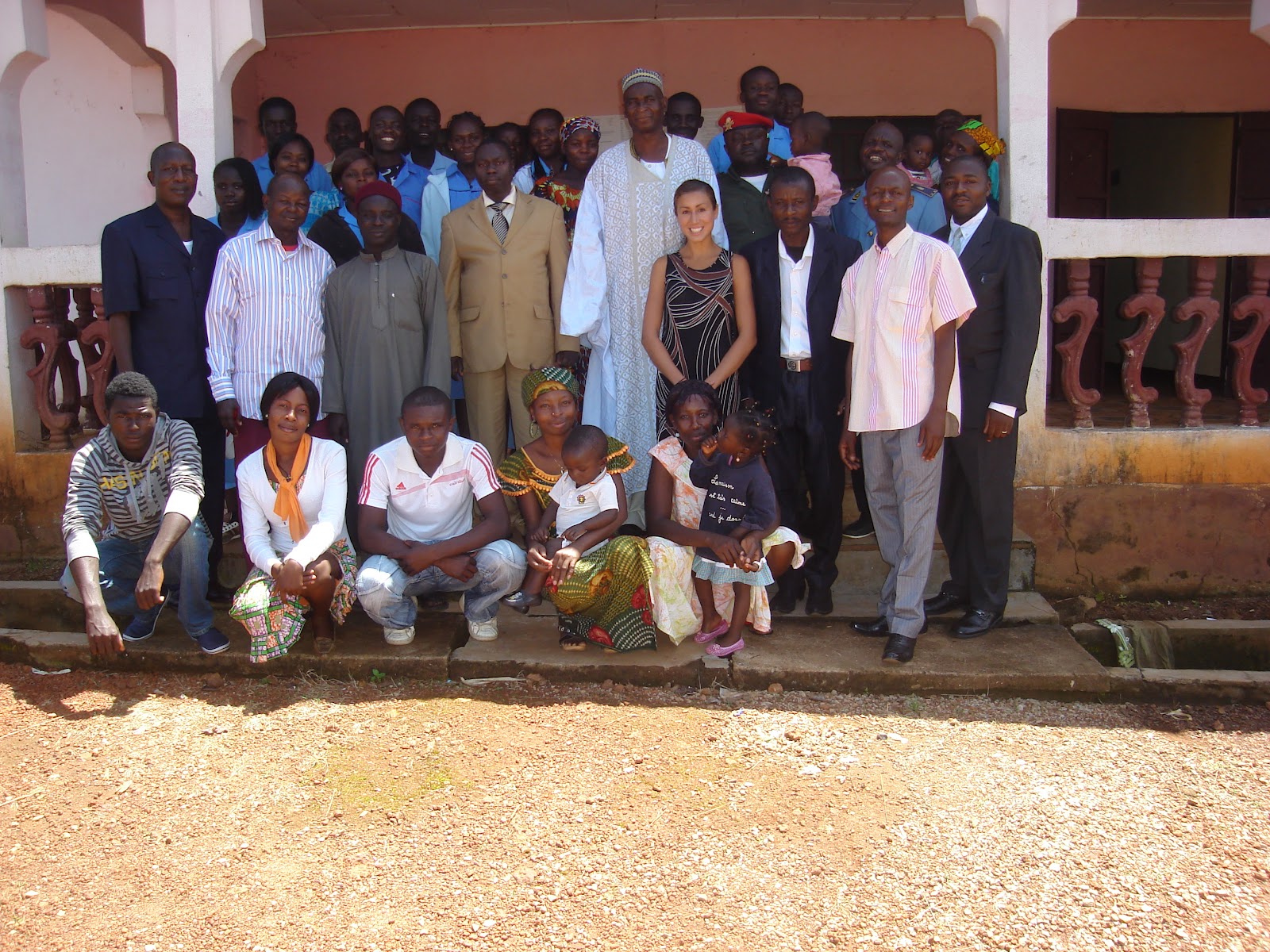
Last week, we succesfully put on Dir's first "Peer Educator Formation". Here we are taking a "family picture" after the opening ceremony! (You can see the traditional chief behind me) Working with the Youth Delegate, Nurse Romeo, and some of the highschool teachers we were able to take 10 students from the highschool and 8 youth from the community to teach them about the obstacles and issues that face a teenager (with a strong focus on how to choose a positive life and sexual health). The youth we chose were incredible, and really participated in the sessions and have already presented a session about HIV/AIDS to their peers at the high school! Our goal now is that we will continue to see each other once a week (just me and the youth) to continue learning about the subjects they have questions on, and also empowering them to learn how to teach these subjects to their peers. Our major goal is to have a big say in the activities surrounding International HIV/AIDS day, December 1st, 2012.

In order to keep the youth engaged throughout the day, we broke up the sessions with activities such as putting on sketches, games, and animations. Here the youth are taking a (much needed) mid-morning break by playing a game of musical chairs!

I believe I have mentioned before how theatrical of a people Cameroonians are. Its amazing to see how quickly Cameroonians can put together an organized song, sketch, or dance. Here we are practicing a song that they ended up performing for the closing ceremony. They also presented a dance emphasizing the importance of wearing condomns, and put on a sketch about a young girl who disobeyed her older sister's advice and gets infected with HIV.
As the doctor always says at the end of his surgeries, "That's all folks!" (The Doc used to watch Bugs Bunny as a young goober).
Subscribe to:
Posts (Atom)